Every competing homeland theory for Proto-Indo-European carries a political history of its own — and knowing that history is essential to evaluating the linguistics. Part 2 surveys the full landscape of discarded and surviving homeland theories, from Nazi-era northern European claims to the current Pontic steppe vs. Anatolia/Armenia debate.
Dr. Elst traces how the northern European homeland theory was politically weaponised by Gustaf Kossinna and the SS research department, before pivoting to the far more serious question of the Anatolian hypothesis (Colin Renfrew, 1990s) and the Armenian/south-Caucasian alternative proposed by Soviet scholars Gamkrelidze and Ivanov and recently revisited by Paul Hagerty. He explains why Hittite, despite being linguistically more archaic than Sanskrit in several features, is not necessarily older — because language evolution is non-linear. The session closes with a sharp observation: the “oldest language” debate in India, where Tamil is sometimes claimed as pre-Vedic, ironically requires accepting the same Aryan invasion logic its proponents claim to oppose.
About the speakers:
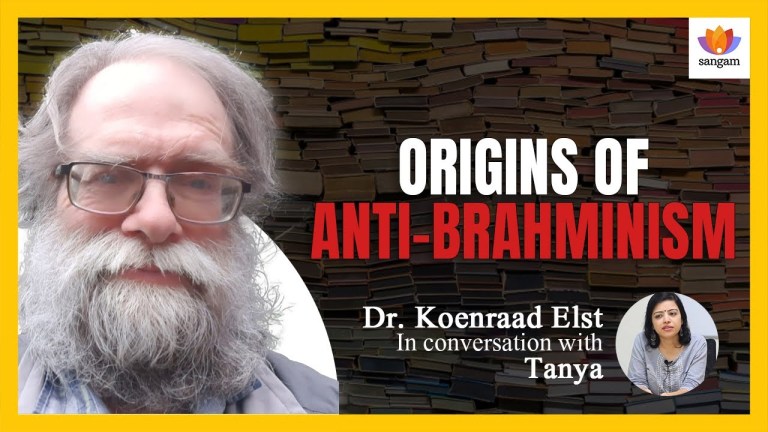
Dr. Koenraad Elst is a Belgian Indologist with Master’s degrees in Indology, Sinology, and Philosophy, followed by original fieldwork at BHU and a doctorate on Hindu nationalism. He is known as an oriental philologist and historian, as well as an independent researcher. One of the few Westerners actively defending Hinduism, he is known for his blunt and objective views, with a dissertation (prepared without any funding) on the ideological development of Hindu revivalism in India. He earned his Master’s degrees in Chinese Studies, Indo-Iranian Studies, and Philosophy at KU Leuven. He completed one year of postgraduate research in Indian philosophy at Banaras Hindu University and was accepted for a Ph.D. in Buddhist Studies. He completed a doctorate in 1998 in Asian Studies.
Dr. Ramakrishnan Sitaraman is a microbiologist by training, with research interests in microbial pathogenesis, gene regulation, and science education. He received his doctoral degree from the University of Alabama at Birmingham (U.S.A.) and conducted post-doctoral research at the National Institutes of Health (U.S.A.) and Vanderbilt University (U.S.A.). Currently, he is a faculty member in the Department of Biotechnology at the TERI School of Advanced Studies, New Delhi, India.