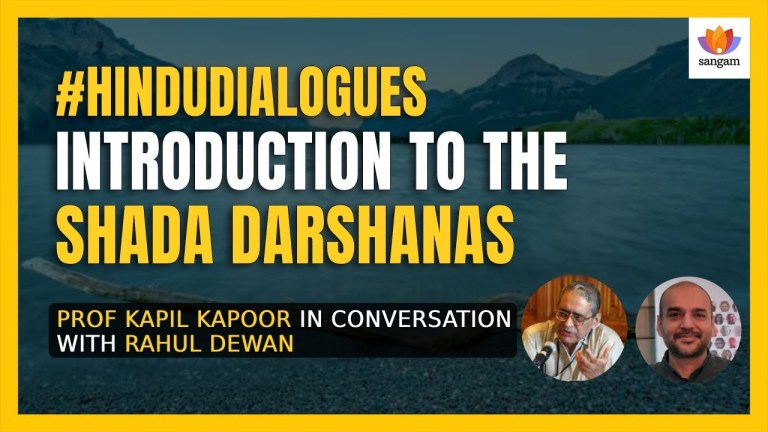
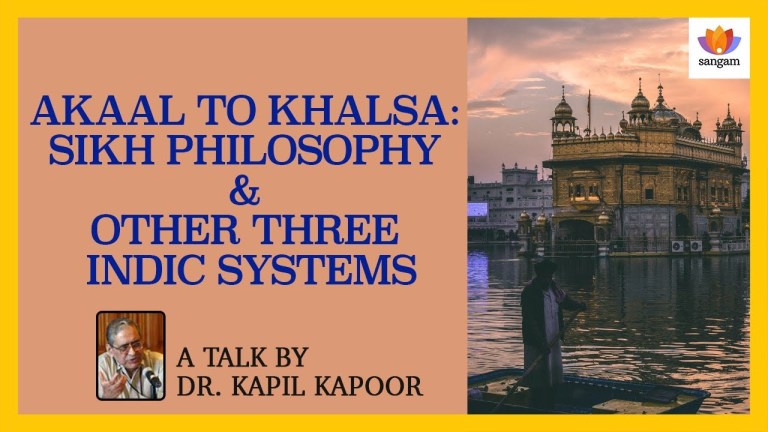
Western civilisation makes gods of men. Indian civilisation makes puny mortals of gods. These are not just different religions — they are opposite knowledge cultures. Prof. Kapil Kapoor opens with the fundamental distinction: Indic civilisation is a knowledge-centred civilisation — its way of knowing, its epistemology, its philosophy of language and reality are the alternative to the Western knowledge culture. And because our knowledge culture is the alternative, the Western academy’s persistent attacks on Indian civilisation make perfect sense — they are attacking a genuine competitor.
The epistemological framework he elaborates is about constructed versus actual reality: no culture directly cognises reality as it is. Every civilisation builds a conceptual world from the raw complexity of the universe. The question is: on what basis? The Vedic answer draws on Shabda (word/sound), pratyaksha (direct perception), anumana (inference), and agama (tradition) — a multi-modal epistemology that treats language as ontologically primary. The Abrahamic knowledge culture, by contrast, is built on a creation narrative that posits radical separation between creator and creation — the Cartesian split — which is the root of both Western scientific achievement and Western ecological destruction.
Prof. Kapoor’s closing provocation: we are a civilisation that, unlike Homer, has made puny mortals of our gods. That needs to change.
About the Speaker:
Prof. Kapil Kapoor, a Member of Exec Council – NMML (Now PMML)
Member High-Level Committee, IKS, Ministry of Education
Chairman – Editorial Committee, Indian Historical Records Committee, National Archives
Formerly Prof Kapoor was: Chairman of IIAS, Pro VC – JNU,
Chairman, MHRD, Language Expert Committee
Professor of English at JNU where he also established the Centre for Sanskrit Studies
He is the editor-in-chief of the unique 11-volume set of The Encyclopaedia of Hinduism
And also of the Sahitya Akademi Sponsored and yet to be published – Encyclopaedia of Indian Poetics which is also a UNESCO project