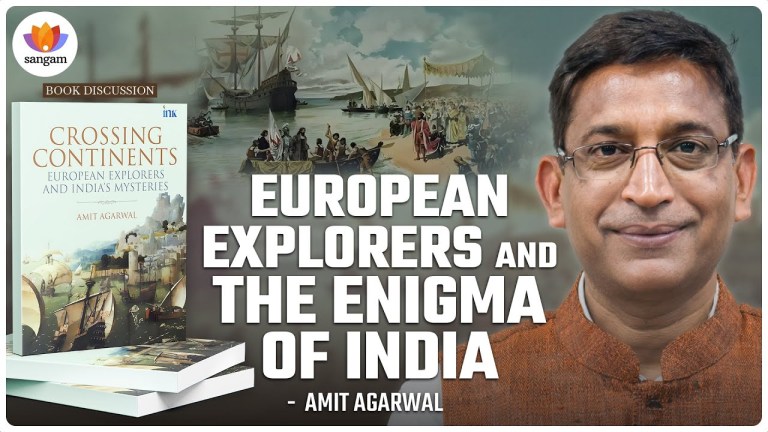
Can a civilization be invaded for 1,300 years and still survive? Bijeet Prasantha and author Amit Agarwal answer this in a conversation that is as historically rigorous as it is provocative.
Amit opens with a devastating Urdu couplet by 18th-century poet Altaf Hussain Hali — a Muslim voice lamenting that Islam’s ship, which conquered seven seas, finally drowned in the Ganges. He then builds a structural argument for why: India’s population of 10 crore, its staggering geographical diversity (deserts, mountains, rivers, plateaus), and crucially its decentralized political system made total conquest mathematically impossible. Even Aurangzeb privately wrote that exterminating India’s Hindus was “completely impossible.” Compare this to the Aztec Empire, which collapsed in under an hour when Cortez captured its single king. Egypt, Persia, and Greece followed the same fate — a centralized head severed, a civilization erased within a generation. India kept regenerating. The pillars of that regeneration: temple ecosystems that secretly relocated sacred idols before invaders arrived; the Bhakti movement offering what Amit calls “salvation through dance and music — a tradition found nowhere else in the world”; Tantra-Mantra practices that so terrified Mughal and British forces that armies literally fled Assam; women warriors like Nayaki Devi who defeated Mohammed Ghori in 1170; and a Hindu merchant class that controlled 25% of world GDP even through the height of Mughal rule, enabling figures like Shanti Das Jhaveri to check Aurangzeb’s aggression directly.
Bijeet Prasantha then presents his own research — a thick volume built from Islamic primary sources (Barani, Firishta, Masir-i-Alamgiri) proving genocidal intent behind every major temple destruction. His thesis: acknowledging this 1,300-year genocide is the non-negotiable first step toward genuinely decolonizing India. He closes with an unflinching demographic imperative — maintain the 80% Hindu majority, stop conversions, and have three to four children.
About the Speaker:
Bijeet Prasantha is a theoretical particle physicist turned investment banker who has a deep interest in the history and culture of Bharat. After obtaining his Bachelor of Technology from Indian Institute of Technology Delhi, Bijeet pursued his Ph.D. in Quantum Chromodynamics from Carnegie Mellon University, Pittsburgh. Currently, he is engaged in quantitative modelling of various equities and fixed income products in finance. This book is a dispassionate analysis of Bijeet’s decade-long research on how the Bharatiya civilisation was heavily impacted by the countless genocidal invasions waged by foreign marauders, and how the elements of Hindu genocide are still active in the sub-continent.
Amit Agarwal is an engineer from the University of Roorkee (now IIT Roorkee). Currently working for a prestigious company, he took time out for the subject he is passionate about. He is an avid marathoner and mountaineer, too. He has published his first book, “Swift Horses Sharp Swords,” and his second, “A Never-Ending Conflict,” both on Indian history. His first book has also been translated into Hindi. His third book, Temple Treasures: A Journey through Time, on the history of temples, was gifted to PM Modi. His fourth book, Crossing Continents, was on the critical observations of European travellers to India in the medieval era. His latest book, Not Just Kohinoor, about the looted diamonds from India, has been recently published.