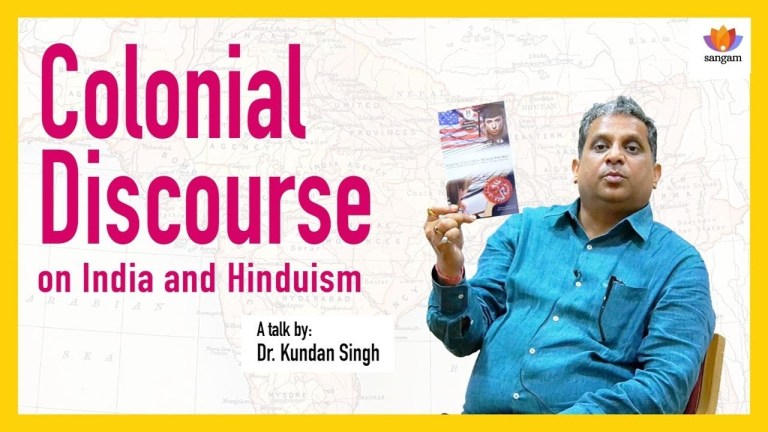
James Mill never visited India, yet his history of British India became the textbook from which Indians learned to hate themselves. This incisive talk on Colonial Discourse and the Suffering of Indian American Children — a rigorously academic work published by Palgrave Macmillan — examines how Orientalist colonial frameworks became institutionalised in India’s own curriculum in 1852 and continue to shape Indian self-perception today.
The author traces how the British deliberately distorted the Varna-Jati system to create a rigidly hierarchical social structure, then propagated that distortion through universities worldwide. The book was three and a half years in the making and goes beyond the author’s earlier semi-academic Making Children Hinduphobic to provide a complete academic dismantling of the Orientalist apparatus.
The talk identifies why this matters urgently for the global Hindu diaspora: as Western legislatures begin debating “caste discrimination” bills using these very distortions as evidence, Hindu children in America and Britain are being made to feel shame for a system that has been fundamentally misrepresented.
About the Speakers:
Prof Kundan Singh has taught in the areas of Integral Philosophy and Psychology, Contemporary and Traditional Vedanta, Theravada and Mahayana Buddhism, Postmodern Philosophy, Philosophy of Science and Epistemology, Critical Thought and Deconstruction, Postcolonial Studies and Psychology, Cultural and Cross-cultural Psychology, Indian Psychology, Yogic Psychology, and Transpersonal Psychology, among a few others. He is the author of “Colonial Discourse and the Suffering of Indian American Children: A Francophone Postcolonial Analysis” (2024) with Krishna Maheshwari as the co-author. He has co-authored another book with Krishna Maheshwari titled “Making Children Hinduphobic: A Critical Review of McGraw-Hill’s World History Textbooks” (2018).
Dr Rinkoo Wadhera is a researcher and the Director of the Center for Cultural Studies, Sarayu Trust. She is the author of Existentialism and Upanishadic Resolution in Indian English Poetry.