From a jagir in Pune to sovereignty over a vast empire stretching from Kandahar to Calcutta — the Maratha century is India’s most underappreciated story of civilisational reclamation.
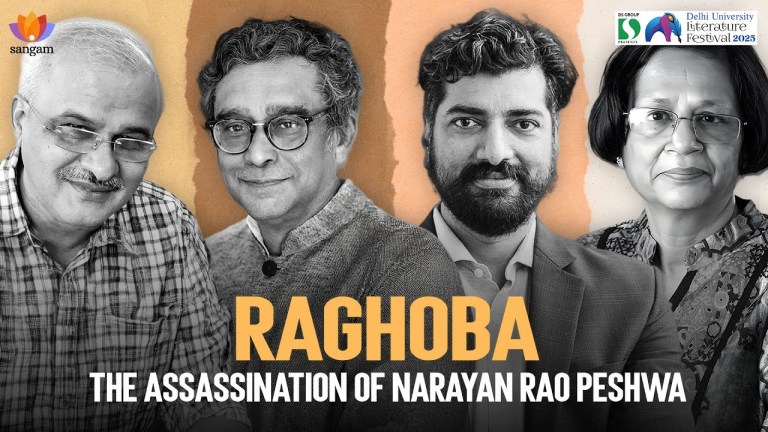
This panel discussion brings together military historian Dr. Kulkarni, author Sohail Hashmi, and a moderator with a defence background to trace the full arc of Maratha power — its visionary origins, masterful battlefield doctrine, and the strategic missteps that left it friendless at Panipat. The conversation opens with Shivaji’s foundational acts: a Sanskrit seal in a Persian-dominated world, a Rajyavyavahar Kosh to purge foreign words from Marathi, and the first deliberate naval construction programme using Portuguese technology — 20 ships that became 200. The panel highlights Bajirao I’s Battle of Palkhed (1728) as the greatest manoeuvre battle on Indian soil — a bloodless victory Montgomery studied — achieved by luring the Nizam away from his artillery and trapping him between a river and mountains without firing a shot. Kanhoji Angre’s coastal fort network (one every 30 miles, within spyglass range) is examined as a doctrine of maritime domain awareness far ahead of its time. The panel then reconstructs how Maratha kingmaking across north India — in Jaipur, Awadh, and Delhi — paradoxically left them without a single ally north of the Narmada by 1761. The session closes with the counterfactual: a Maratha victory at Panipat would likely have denied the British their opening into the subcontinent.
About The Speaker:
Uday Kulkarni – A Surgeon Commander in the Indian Navy and acclaimed writer, he combines a career in service with deep research and authorship on Indian history.
Sohail Rekhy – A versatile novelist, photographer, and journalist, he brings together storytelling, visual creativity, and investigative insight in his work.
Col. Ajay Singh – A veteran of 28 years in the Indian Army’s Armoured Corps, he shares his extensive military experience and perspectives on defense and strategy.