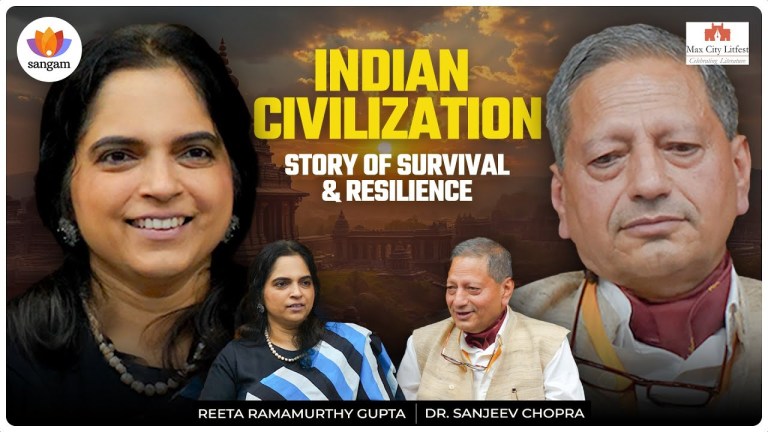
Indian civilisation rests on three pillars — Shastra, Shaastr, and Sadhana. This RKM scholar explains why separating them is destroying our tradition.Delivered at a seminar on Kashmir Shaivism, this short but dense talk draws on Panini’s grammatical concept of “Adarshanam Lopah” — that which is non-visible is not non-existent — to explain why India’s traditions persist even through rupture. The speaker traces the unbroken thread of Kashmir Shaivism from Abhinavagupta through Kerala, where the sadhana lineage survived when it went underground in Kashmir.The core argument: Indian philosophy is not merely logic or metaphysics — it integrates Shastra (protective warrior tradition), Shaastr (textual wisdom), and Sadhana (embodied practice). Losing any one of these weakens the whole. The North-South divide, the speaker insists, is a British-era fabrication with no basis in Puranic geography or lived tradition. The Bindhya mountain range, not colonial administrative lines, is the real reference point of Indian cultural geography.
About the Speaker:
Rajnish Kumar Mishra teaches in School of Sanskrit Studies, JNU, New Delhi. For more than two decades he has taught courses and supervised research in Kashmir Shaivism, Poetics and Aesthetics,Philosophy of Language and Comparative Philosophy. He has been associated with Encyclopedia of Hinduism (associate editor) and Encyclopedia of Indian Poetics (assistant editor). He has published a widely reviewed book “Buddhist Theory of Meaning and Literary Analysis” (1999).