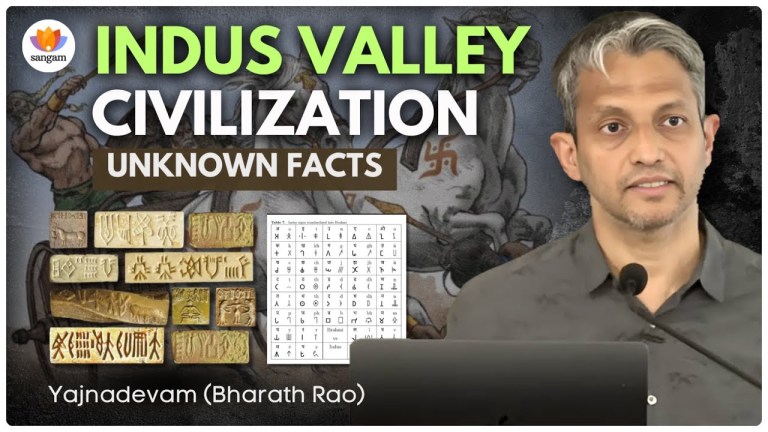
The Indus script has been deciphered — not through guesswork, but through the same rigorous cryptographic mathematics used to crack Mary Queen of Scots’ cipher — and it reads as Sanskrit.
Independent researcher YajnaDevam traces his COVID-lockdown journey from curious observer to rigorous decoder, presenting the mathematical case for his Indus script decipherment at IIT Hyderabad and IISc Bengaluru before this Sangam Talks audience. Using Claude Shannon’s cryptogram uniqueness threshold — which provides a quantitative test distinguishing reliable decipherment from speculative alternatives — YajnaDevam demonstrates that the Indus script yields a single, mathematically reliable decipherment into Proto-Sanskrit. The inscriptions are overwhelmingly religious in nature, referencing Rudra, Vedic gods, and Puranic incidents — confirming that Indus Valley people were Vedic people.
The Brahmi connection is especially striking: a direct visual comparison of Brahmi and Indus characters shows near-identical forms — showing Brahmi was not a new invention but a standardisation of Indus script. Archaeological strata in Kerala and Tamil Nadu confirm the transition chronologically: earliest layers show only Indus script, middle layers show both, upper layers show only Brahmi. Combined with Indian motifs found in Mesopotamian pottery from 6000 BCE and rice cultivation in the Gangetic plains from 9000 BCE, YajnaDevam places India’s civilizational origins at a minimum of 7,000 years — with compelling evidence pushing earlier.
About the Speaker:
Yajnadevam is a cryptographer & computer programmer interested in political theory, linguistics, ancient manuscripts & history. Combining his broad experience in languages & scripts together with programming & regular expressions, he presents his decipherment of the Indus script.