The Rakhigarhi skeleton — celebrated in India as proof against Aryan invasion — may actually demonstrate the opposite. Part 4 turns to contemporary genetic and archaeological scholarship, focusing on the implications of steppe culture discoveries for the Out of India debate.
Dr. Elst carefully explains the Rakhigarhi paradox: the female skeleton from the Harappan site showed zero steppe-genetic contribution, which mainstream Indo-Europeanists like Martin Kuhn read as confirming that steppe admixture arrived after the Vedic culture was already established in India — not as proof of indigenous continuity. The key question is whether Vedic culture predates the steppe admixture genetically present in modern Indians, which Srikanth Talagiri’s literary analysis of the Rig Veda (published since 2000) systematically argues.
The session also covers the Druhyu tribe’s expulsion from India as recorded in the Rig Veda itself — a narrative thread that, if historical, would place Indians as the people who migrated out into the Yamnaya steppe and eventually into Europe, not the reverse. Consonant-cluster typology linking PIE to Northwest Caucasian languages adds further texture.
About the speakers:
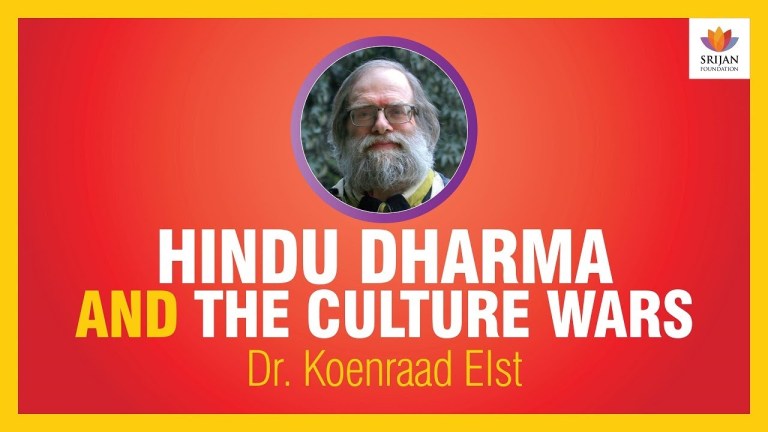
Dr. Koenraad Elst is a Belgian Indologist with Master’s degrees in Indology, Sinology, and Philosophy, followed by original fieldwork at BHU and a doctorate on Hindu nationalism. He is known as an oriental philologist and historian, as well as an independent researcher. One of the few Westerners actively defending Hinduism, he is known for his blunt and objective views, with a dissertation (prepared without any funding) on the ideological development of Hindu revivalism in India. He earned his Master’s degrees in Chinese Studies, Indo-Iranian Studies, and Philosophy at KU Leuven. He completed one year of postgraduate research in Indian philosophy at Banaras Hindu University and was accepted for a Ph.D. in Buddhist Studies. He completed a doctorate in 1998 in Asian Studies.
Dr. Ramakrishnan Sitaraman is a microbiologist by training, with research interests in microbial pathogenesis, gene regulation, and science education. He received his doctoral degree from the University of Alabama at Birmingham (U.S.A.) and conducted post-doctoral research at the National Institutes of Health (U.S.A.) and Vanderbilt University (U.S.A.). Currently, he is a faculty member in the Department of Biotechnology at the TERI School of Advanced Studies, New Delhi, India.