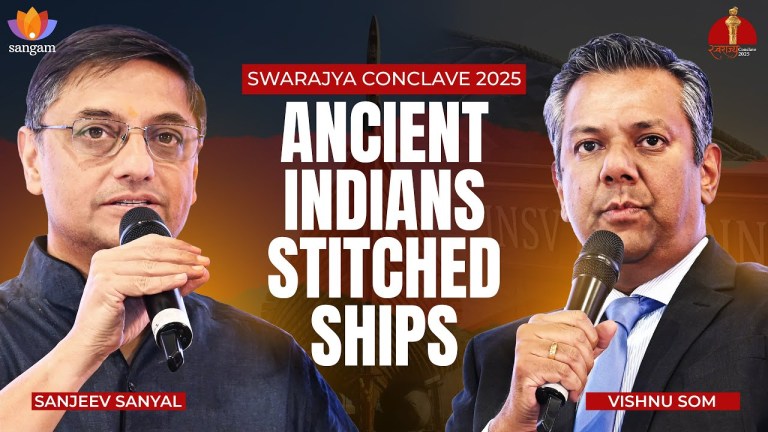
India is the only country in the world with an ocean named after it — and the ancient stitched ship technology that once connected Bharata to Korea, Rome, and Bali is about to sail again.
In this tightly argued history lecture, economist and EAC-PM member Sanjeev Sanyal traces India’s maritime arc from Dholavira — once the world’s largest port, now landlocked in the Rann of Kutch — through monsoon-powered ocean crossings by the 1st century AD, to Pallava and Chola maritime empires whose cultural reach extended to Cambodia, Vietnam, Korea, and Japan. He explains why Indian ships were stitched rather than nailed — not because Indians couldn’t make rust-free iron (the Delhi Iron Pillar proves they could) — and acknowledges the single fatal flaw: stitched hulls couldn’t absorb cannon recoil.
Sanyal announces the Stitched Ship Project: a 21-metre vessel based on an Ajanta cave painting, to be built over eighteen months and sailed on the ancient Bali Jatra route from Odisha to Southeast Asia — recreating a voyage that hasn’t been attempted in this form for over a thousand years.
About the Speaker:
Shri Sanjeev Sanyal is currently the Principal Economic Advisor to the Government of India and also represents India on a number of international forums.
He is also a well-known urban theorist and writer. His best-selling books include Land of the Seven Rivers, The Indian Renaissance, India in the Age of Ideas, and The Ocean of Churn.