Dr. S Kalyanaraman

Dr. S Kalyanaraman is a life-member of and regular participant in the World Association of Vedic Studies. He has authored many books on Sarasvati-Sindhu Civilization and vedic studies. He is National President of Rameshwaram Rama Setu Protection Movement and Director, Sarasvati Research Centre of Akhila Bharatiya Itihasa Sankalana Yojana. He has a Ph.D. in Public Administration from the Univ. of Philippines and degree in Economics and Statistics from Annamalai University.

maxresdefault - 2024-10-30T120125
Sarasvati Civilization (Part 8): Primary Sources Of History | Dr. S Kalyanaraman
Dr. S. Kalyanaraman quotes all the primary historical sources that lead us to de-codification of the Sarasvati Sindhu civilization. He says that Neolithic culture has emerged in different parts of Bharat. The maps of post Harappan Iron Age pottery sites in the greater civilization in Asia right up to Middle East and Iran are available. The seals and hieroglyphs are not just artifacts, they depict entire lifestyle and the professions like guild master, wealth keeper, blacksmiths, metal alloy artisans, jewels and gems artisans etc. The remarkable documentation...
maxresdefault - 2024-10-30T120052
Sarasvati Civilization (Part 7): Language And Culture | Dr. S Kalyanaraman
Language and culture of Sarasvati Sindhu Civilization is discussed in detail by Dr. S. Kalyanaraman. The researches reveals that Meluha was a language union of all Bharatiya languages, it was spoken dialect of artisans, seafaring merchants of Sarasvati Sindhu Civilization. All the tablets and seals of metal alloys from various parts of civilization tell stories of artisans and metal workers through hieroglyphs. They also indicate that words used in all Indian languages have same roots. Genetic affinities of Bharat Janam have been conclusively established...
maxresdefault - 2024-10-30T111938
Sarasvati Civilization (Part 6): Economy | Dr. S Kalyanaraman
Dr. S. Kalyanaraman talks about the Economic activity during Sarasvati-Sindhu Civilization. The locus of the activity of Rigvedic times is around Spatasindhavah, the seven rivers that fed the civilization namely: Sarasvati, Sindhu, Shatadru, Vipasha, Purushni, Asikni, Vitasta. All these rivers were navigable and were vital for the economy to develop. The Janapadas started evolving all through the land up til Srilanka and all four directions of Bharat Janama as mentioned by Vishvamitra in the Rig Veda. He goes on to explain the meanings of the seals, decoding...
maxresdefault - 2024-10-29T113551
Sarasvati Civilization (Part 5): Technology | Dr. S Kalyanaraman
Dr. S. Kalyanaraman explains how the Technological development of a civilization adds up to the trade activity and contributes to the wealth of that nation. Quoting from Rigveda he says the mind of the artisan is yoked together in a technological framework and the thought process combines mind with materials resulting into Technology. He discusses in detail the seals and artifacts of 6th century BC that depict via pictographs the Tin bronze technology and copper evolution. The signs of metallurgy, drilling, weaving, bleaching, dyeing as well as inscribing...
maxresdefault - 2024-10-29T112326
Sarasvati Civilization (Part 4): Wealth of Nations | Dr. S Kalyanaraman
The four main components that form wealth of a nation are Land, labour, capital and organisation. Dr S Kalyanaraman explains the role played by each of these in generation of wealth of Bharat. Indian soil was rich alluvial soil due to Himalayan rivers and rich also in terms of metal ores. The seals from Saravati-Sindhu Civilization from 3 century BC speak a lot about Bharat as a country rich in metal, material, alloys, cotton, silk, herbal products and developed agriculture. Evidence of cultivated land, water resources used productively, water management...
maxresdefault - 2024-10-29T112012
Sarasvati Civilization (Part 3): Trade | Dr. S Kalyanaraman
As Dr. S. Kalyanaraman says Trade is a way of social interaction where people exchange goods. He goes on to give a detailed account of the seals and pictographs that decipher this aspect of Sarasvati -Sindhu Civilization. There is ample evidences for long distance trade transactions with India as centre point, the focus was on the Ancient maritime Tin route. The seals signify the metal trade ways of Meluha people through hieroglyphs depicting the Tin trade route of Bronze Age. The Meluhan merchants used the technology and wealth resources to trade across...
maxresdefault - 2024-10-29T110453
Sarasvati Civilization (Part 2): Geography & Polity | Dr. S Kalyanaraman
Dr. S. Kalyanaraman discusses in detail the cultural framework governed by geology and the polity of Janapadas. He talks about the ancient migrations and the routes of traditional settlements through out Sarasvati-Sindhu basin. People travelled for various reasons, the alluvial productive rich soil, the emergence of the tirtha sthals on the banks of rivers, the trade contacts of different parts of the country. He insists that the entire country should be studied as a whole to understand its civilization and the riches that made it globally known resulting...
maxresdefault - 2024-10-29T110148
Sarasvati Civilization (Part 1): Samudramanthan | Dr. S. Kalyanaraman
Dr. S. Kalyanaraman has been deciphering Harappan symbols for a long time and also working on Sarasvati Valley Civilization. In the present talk he talks about the cosmic phenomena of Samudra Manthan or churning of ocean that churned out Amrit and Vish, Health giving herbs, Art and culture and many material products and Sagar Mata, the Himalayas. The Himalayan Rivers that were navigable, provided transport system as well as carried minerals and ores, were Life line of Bharat Varsha. The Sarasvati river basin was the epicentre of Sarasvati-Sindhu Civilization....
maxresdefault - 2024-10-28T141137
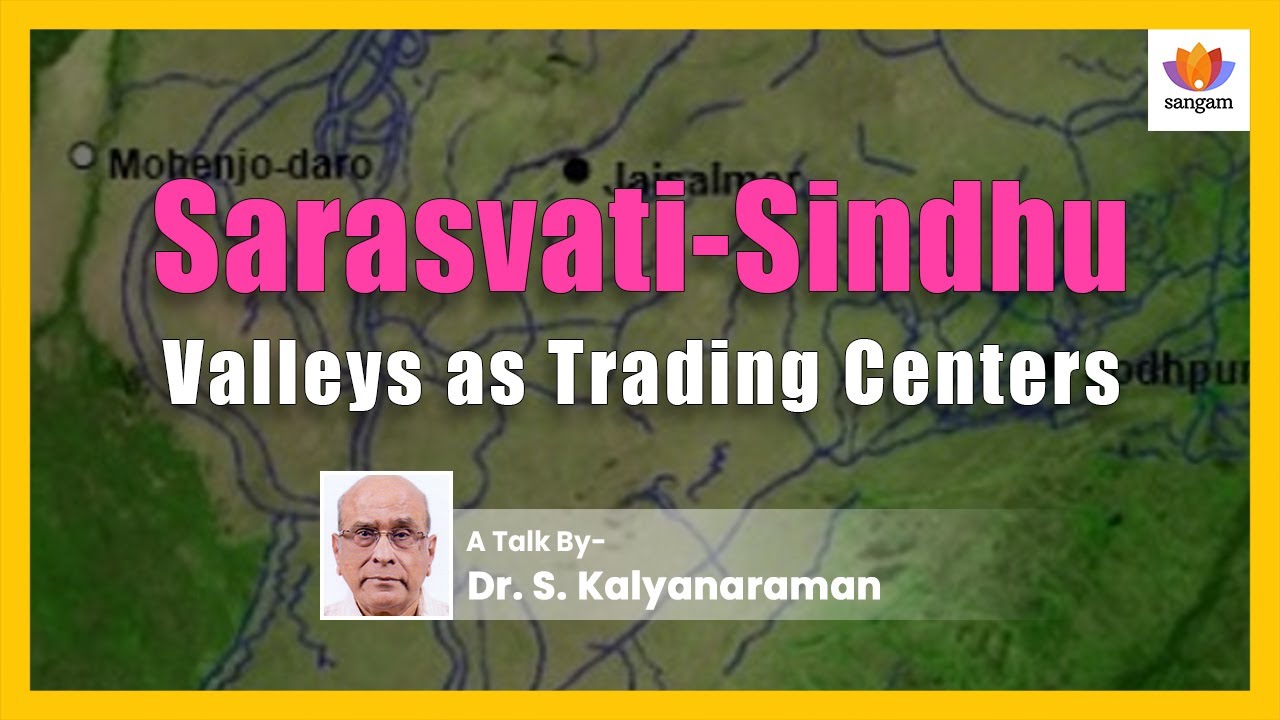
Saraswati-Sindhu Valleys as Trading Centres: 4th Millenium BCE -- #SangamTalk By Dr. S Kalyanaraman
The talk furthers an understanding of the lost Sarasvati River. It gives deeper insights into an ancient civilization that flourished on the Sarasvati and Indus river valleys circa 3000 BC. It reveals and enumerates the various aspects of the lost Civilization of the Sarasvati-Sindhu valley, its importance as a trading and cultural center, and the wealth it brought to Ancient India. It delineates the evolution, unity, and scope of the ancient Indian languages and lists the symbols of the Indus valley civilization, discusses the Tin-bronze revolution of the...

Sarasvati Civilization (Part 6): Economy | Dr. S Kalyanaraman

Dr. S. Kalyanaraman talks about the Economic activity during Sarasvati-Sindhu Civilization. The locus of the activity of Rigvedic times is around Spatasindhavah, the seven rivers that fed the civilization namely: Sarasvati, Sindhu, Shatadru, Vipasha, Purushni,..

Sarasvati Civilization (Part 6): Economy | Dr. S Kalyanaraman

Dr. S. Kalyanaraman talks about the Economic activity during Sarasvati-Sindhu Civilization. The locus of the activity of Rigvedic times is around Spatasindhavah, the seven rivers that fed the civilization namely: Sarasvati, Sindhu, Shatadru, Vipasha, Purushni,..